Posts tagged Storytelling
Fundraising Event Trends: Why People-Centered Events Win
 

Golf is a Relationship Sport—The 2026 Data Says Fundraising Is, Too

by Samantha Swaim, Founder and Fundraising Event Consultant at Swaim Strategies

Four hours on a course does something a ballroom rarely can. It strips away the formality. It puts four people in a cart, side by side, with time to talk. That is why the charity golf tournament remains one of the most resilient fundraising events in the nonprofit toolkit.

But the ground under every fundraising event is shifting. The 2026 numbers give us a clearer picture. Fewer people are giving, the people who stay are giving more, and the events that win are built around human connection rather than headcount.

If you produce golf tournaments, this is good news. Here are six fundraising event trends that shaped 2026, what the research says, and how to put them to work on your course.

Trend 1: Fewer Donors, Deeper Relationships

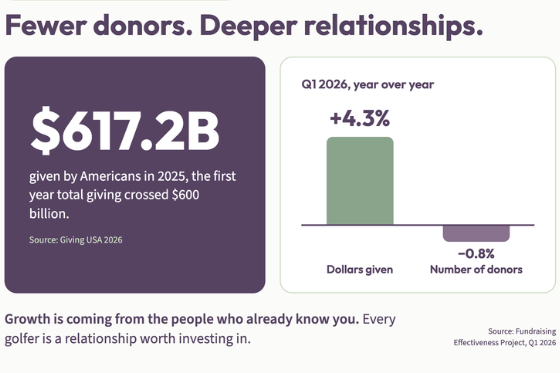
Americans gave a record $617.2 billion in 2025, the first time total giving crossed $600 billion, according to Giving USA 2026. Yet the same report shows fewer Americans are participating.

The quarterly data confirms it. The Fundraising Effectiveness Project found that in the first quarter of 2026, dollars rose 4.3% while the number of donors fell 0.8%. Growth is coming from existing and returning supporters, not from new ones.

Meanwhile, the Center for Effective Philanthropy reports that 69% of nonprofits lost funding from at least one source in 2025. Many are turning to individual donors to close the gap.

What this means for your tournament: Every golfer is now a relationship worth investing in. The question is no longer, "How do we fill foursomes?" It is, "Who should be on this course, and what should they feel when they leave?"
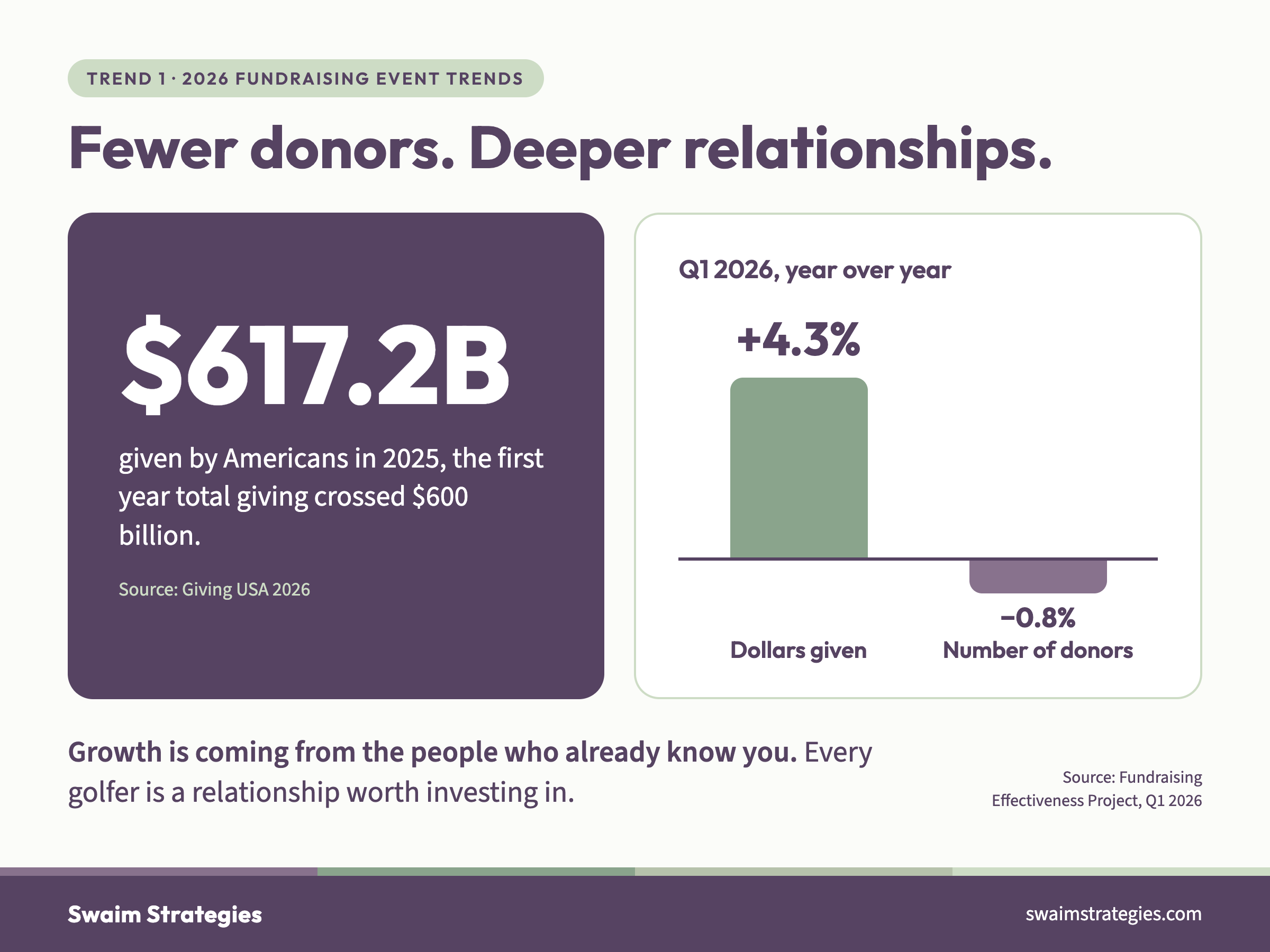
An infographic titled "Fewer donors. Deeper relationships." with the caption "Growth is coming from the people who already know you. Every golfer is a relationship worth investing in."
 

Trend 2: Smaller, Curated Fields Can Outperform Full Ones

Bigger is not automatically better. In a recent Swaim Strategies case study, a museum gala turned 75 guests into $400,000. The strategy started with a donor prospect map, not a venue. Every seat was a deliberate decision, and every guest had a named relationship holder and a defined outcome for the night.

The same logic applies on the course. A curated field lets you:

  • Pair intentionally. Place a board member, a program leader, or a client of your work in each foursome so every round is also a cultivation conversation.

  • Map before you market. Tier your invite list by history, affinity, and relationship before you open registration.

  • Know the money before the tee time. Plan sponsorships, foursome hosts, and pledges first, then design the day around the people who belong there.

  • Spend staff time on people, not logistics. When asks are mapped in advance, your team spends the day in high-value conversations instead of triage.

A smaller field also costs less to produce. That matters when every dollar raised needs to reach the mission. If you are unsure where to start, a strategic plan for your fundraising event builds the revenue architecture before you book a single cart.
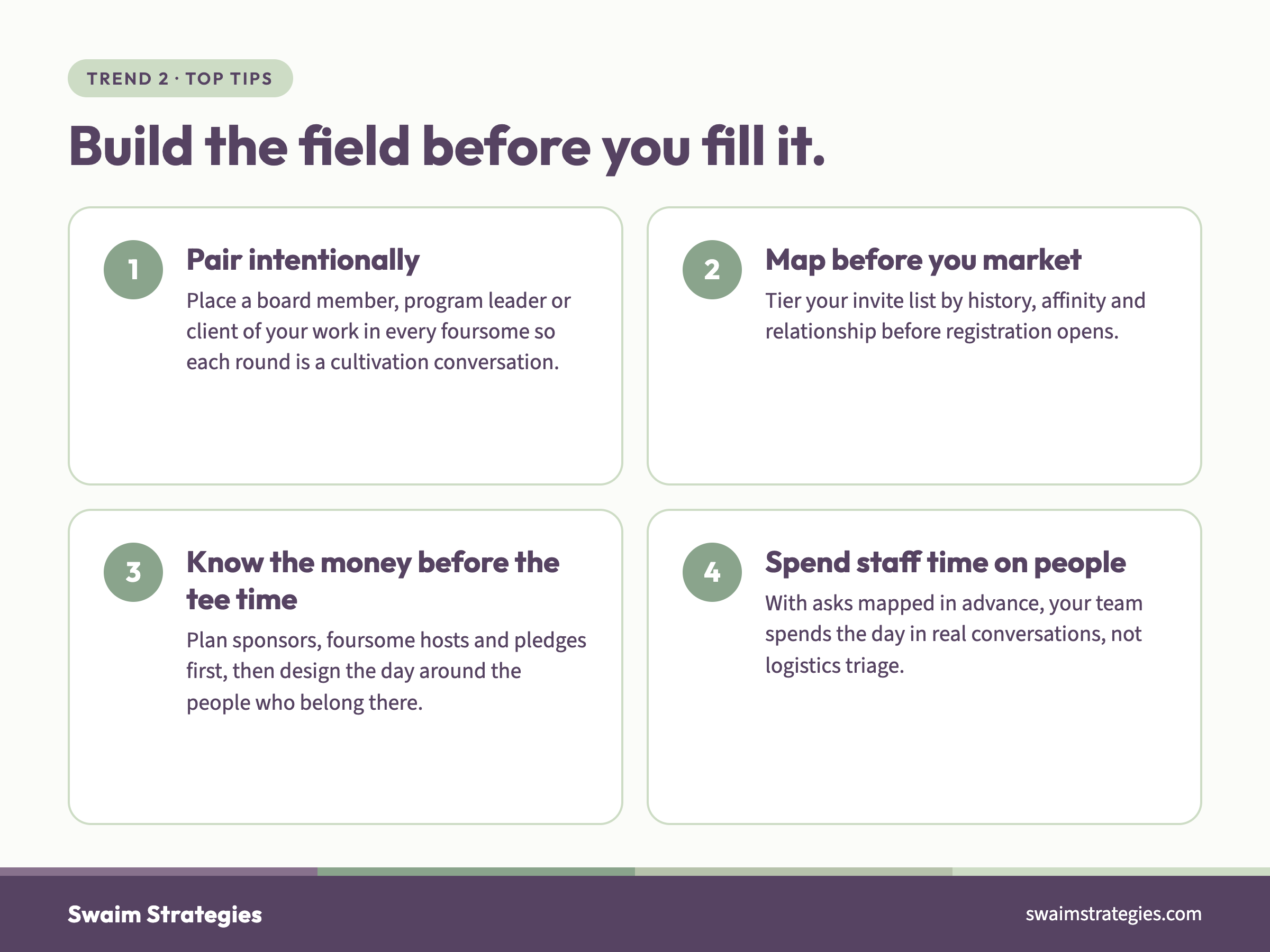
An infographic with the title "Build the field before you fill it." with the points "1. Pair intentionally, 2. Map before you market, 3. Know the money before the tee time, 4. Spend staff time on people."
 

Trend 3: Belonging & Mission Bring People Back

People don’t come back just for the scramble format. They come back because they felt part of something.

The Bloomerang 2026 Giving Signals Report found that 97% of Millennial donors say giving makes them feel part of something. Belonging is now a reason people give the first time, not just a reason they stay. And 80% of Millennials plan to support at least one new nonprofit this year. Many of them are the young professionals now joining the game in record numbers, as GolfStatus notes in its guest post on golf fundraising trends.

Giving circles show the same pull. According to the Johnson Center for Philanthropy, 4,000 giving circles mobilized 370,000 people to give $3.1 billion between 2017 and 2023, and the movement is on track to double. People want to give together.

A mission-centered golf tournament gives them that. Some ways to bring the mission onto the course:

  • Name holes for impact. Replace a generic logo sign with a photo and one sentence about a person your program served.

  • Station mission ambassadors. Put a staff member, volunteer, or program participant on a hole to greet each foursome and share a two-minute story.

  • Make the turn meaningful. Use the lunch break for a short program that shares your story and includes a paddle raise.

  • Let golfers do something together. A team challenge tied to your mission, like each foursome writing a note to a family you serve, turns individual players into a community.
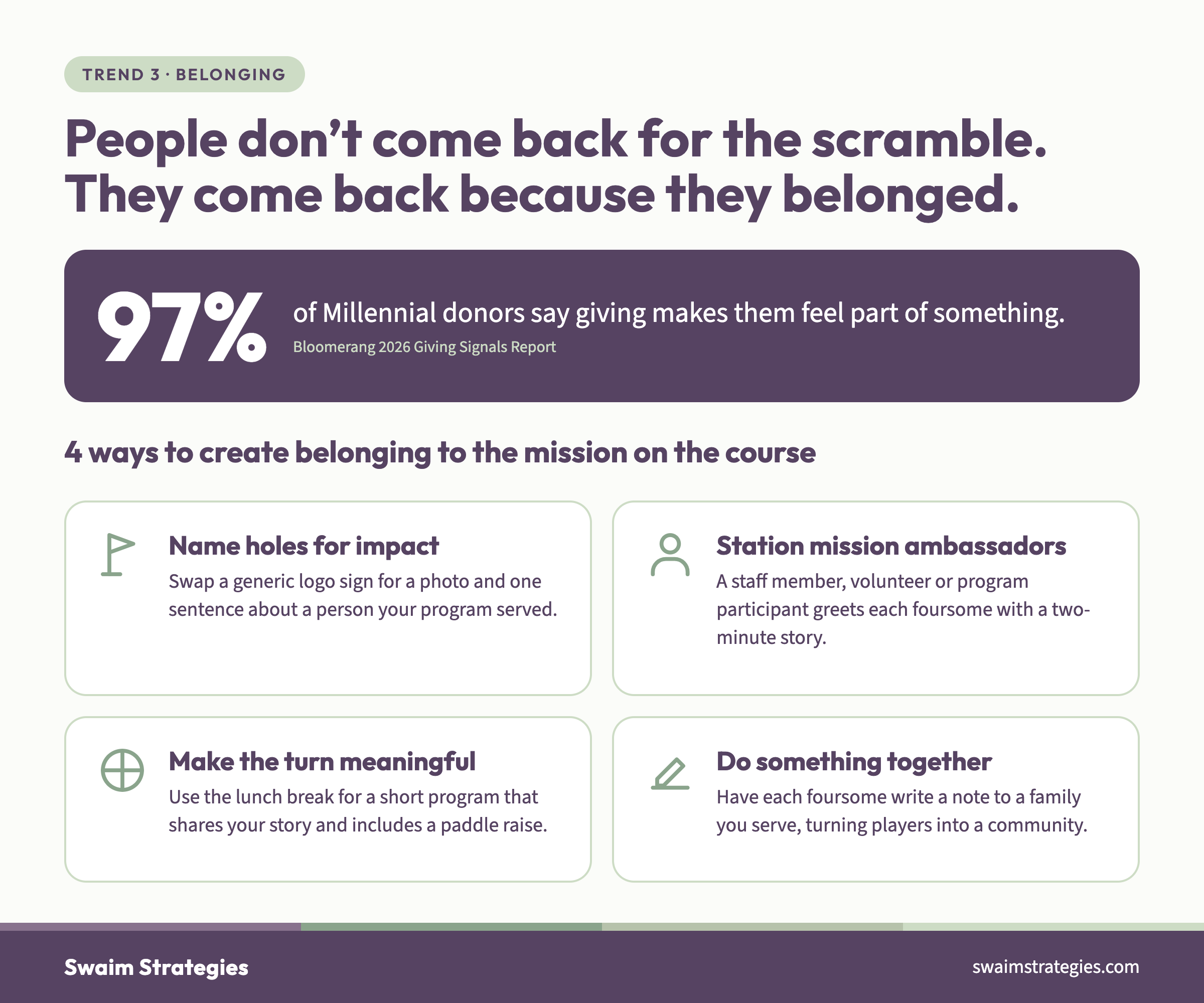
An infographic titled "People don't come back for the scramble. They come back because they belonged." with the tips "Name holes for impact, station mission ambassadors, make the turn meaningful, and do something together."
 

Trend 4: Story-based Programs Turn Golfers Into Donors

Many golf tournaments raise money from registrations and sponsors, then treat the awards dinner as a wrap-up. In 2026, the dinner was where the real fundraising happened, if the program was designed for it.

Event professionals are naming the shift directly. A 2026 gala trends session from Auctria points to a return to human-centered fundraising, with storytelling as the backbone that still raises the most money. The Swaim Strategies case study puts it simply: mission immersion beats mission messaging. Guests who touch the work do not need to be convinced of its value.

Design your post-round program as an emotional arc, not an agenda:

  1. Welcome and celebrate. Recognize the players and the day they shared.

  2. Connect to one person. Share a single, specific story, in a short film or told live by the person who lived it.

  3. Show what is possible. Name what the next dollar will do.

  4. Make the ask at the peak. Invite a special appeal or paddle raise while the room is still moved.

  5. Close with gratitude. Send people home feeling like partners, not customers.

New tax rules give you a natural ask level, too. Starting in 2026, people who do not itemize can deduct up to $1,000, or $2,000 for joint filers, according to Husch Blackwell. Some fundraisers are framing a $1,000 gift as a new tax-smart giving level.

If writing the program feels daunting, complete event scripting and mission-driven video production can help you build the arc from welcome to final thank-you.
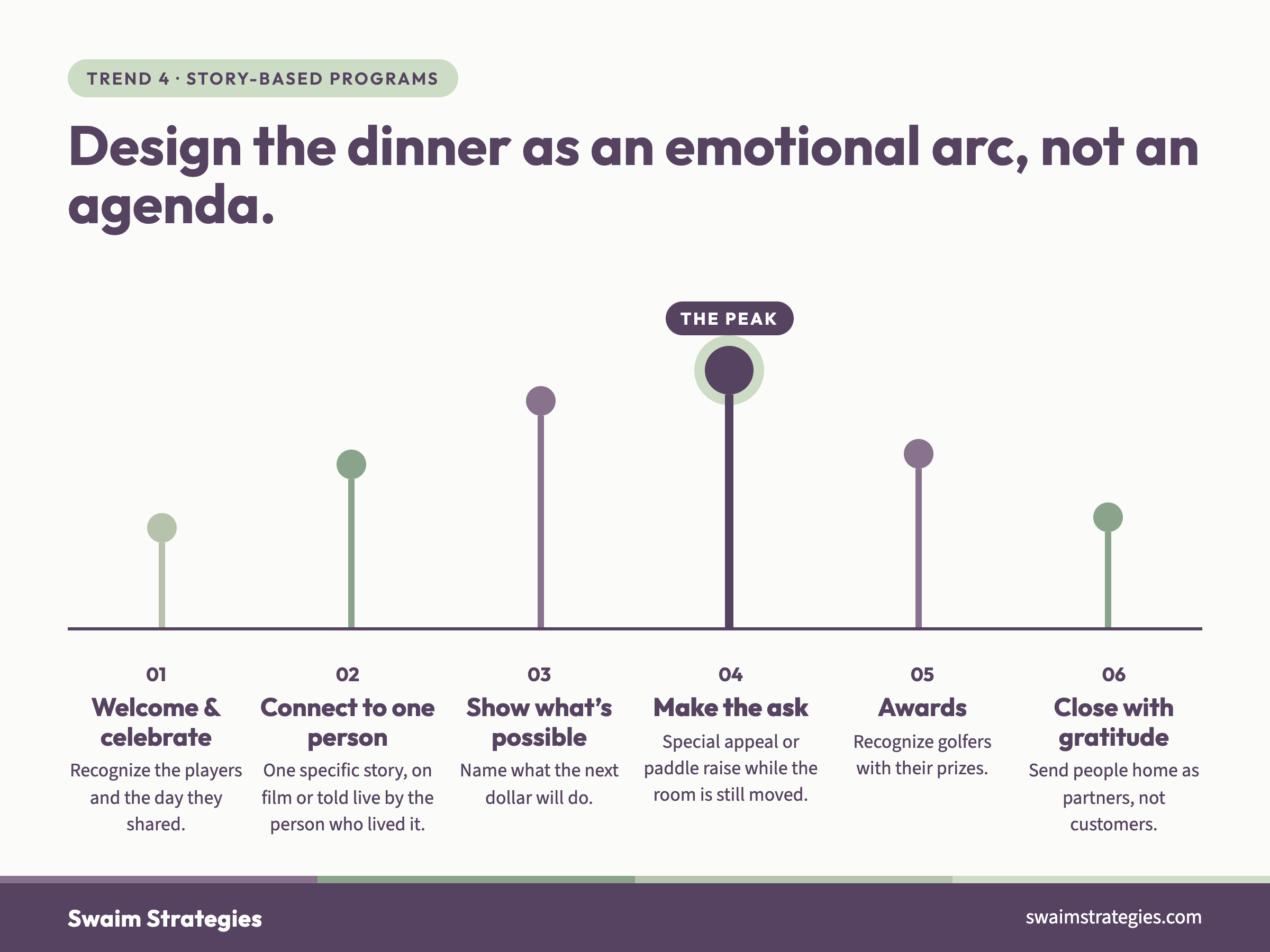
An infographic with the title "Design the dinner as an emotional arc, not an agenda."
 

Trend 5: Sponsors Want Partnership, Not Just a Tee Sign

Corporate support is under pressure. The Chronicle of Philanthropy reports that businesses are pulling back from event sponsorships and table purchases. A new tax rule now gives companies a deduction only on giving above 1% of profits.

For golf tournaments, where sponsors are often the financial backbone, this is a wake-up call. The tournaments that keep sponsors are the ones that treat them as partners. As I wrote in Smarter Sponsorship Strategies for Your Charity Golf Tournament, your sponsorship menu is a conversation starter, not the final word.

What partnership looks like in practice:

  • Start six to 12 months out. Many companies set sponsorship budgets in Q4 for the following year.

  • Ask before you pitch. Learn what a business is trying to accomplish: recruiting, client time, community visibility, or a personal connection to your cause.

  • Co-create the benefit. Offer employee foursomes, a hosted hole with a mission ambassador, or a speaking moment at dinner.

  • Report impact, not impressions. Send photos, outcomes, and a story connected to their investment after the event.

For more ideas, see the 9 proven sponsorship strategies for charity golf tournaments.
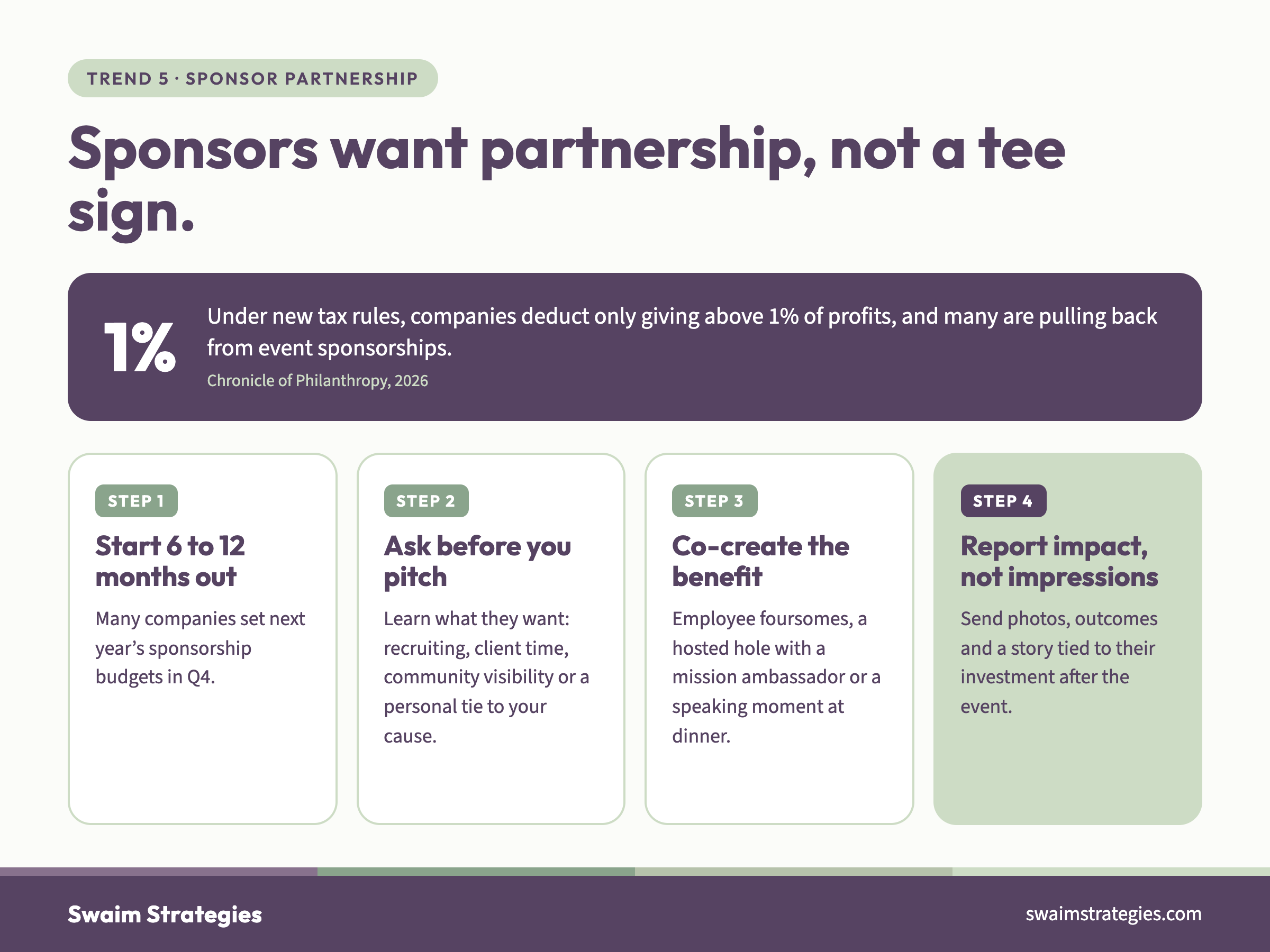
An infographic titled "Sponsors want partnership, not a tee sign." with the points "1. Start 6 to 12 months out, 2. Ask before you pitch, 3. Co-create the benefit, 4. Report impact, not impressions."
 

Trend 6: The Relationship Starts After the Final Putt

The tournament is not the finish line. It is the first tee of a longer relationship.

Retention is where the opportunity hides. Donor retention sat at just 18% in early 2026, per the Fundraising Effectiveness Project. Yet Bloomerang's analysis of FEP data shows retention nearly triples once someone gives a second time. Your job after the tournament is to earn that second gift.

Legacy giving rewards the long view as well. Bequests rose nearly 20% in 2025, the fastest growth of any source, according to the Lilly Family School of Philanthropy. The golfer who has played your tournament for 15 years may be your next legacy donor.

Build a follow-up rhythm:

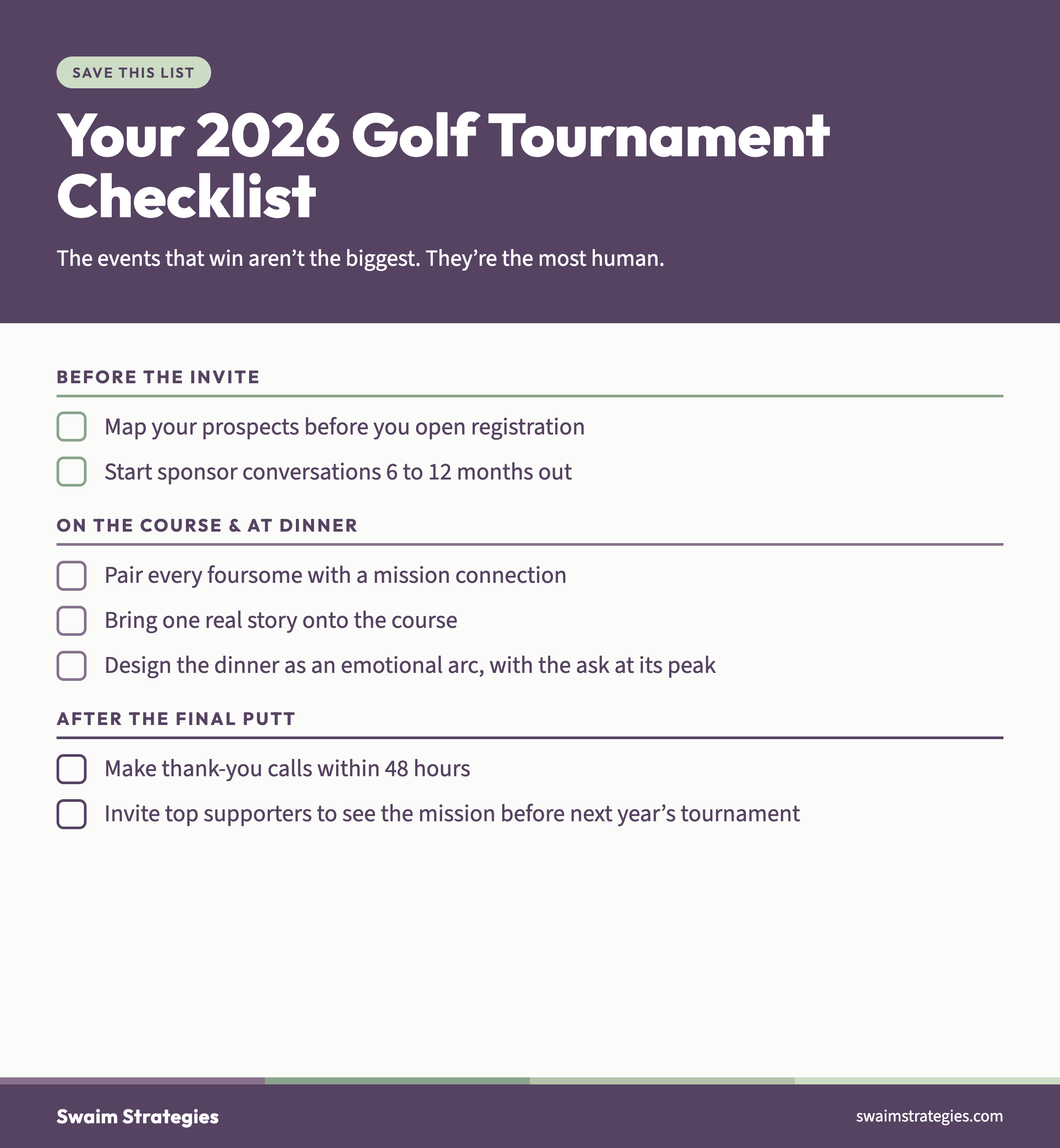
  • Within 48 hours: Make personal thank-you calls to sponsors, foursome hosts, and first-time players.

  • Within 2 weeks: Send an impact note with photos and the story of what their day made possible.

  • Within 90 days: Invite donors to see the mission up close, such as a site visit or volunteer shift.

  • Before next year's invite: Have a personal conversation with your top supporters about their goals and how they want to be involved.

An annual event audit is a smart way to see where your tournament is building relationships, and where it is leaving them on the course.
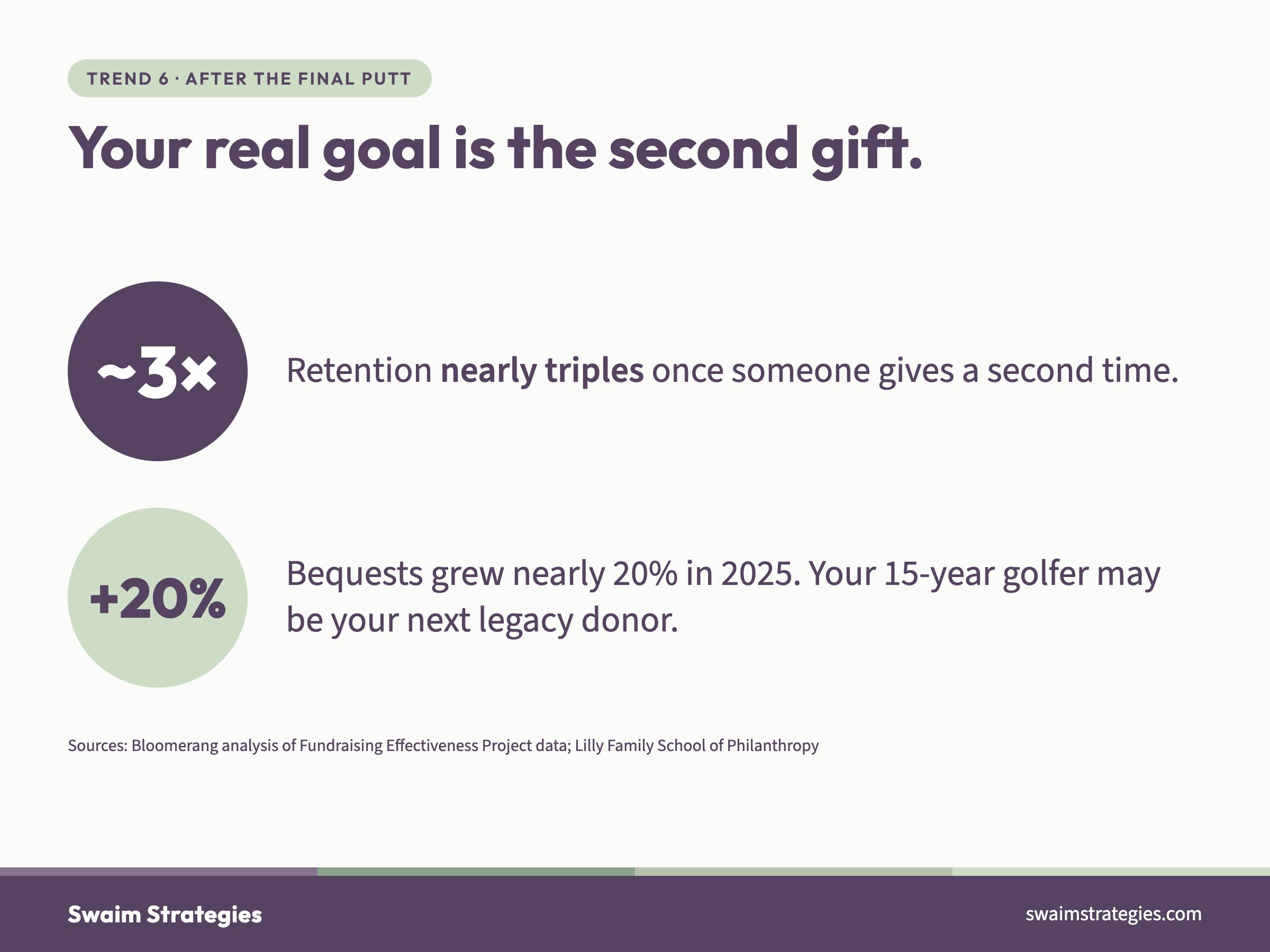
An infographic titled "Your real goal is the second gift." with the stat "Retention nearly triples once someone gives a second time."
 

Your Next Golf Tournament Checklist

An infographic titled "Your 2026 Golf Tournament Checklist" with the caption "The events that win aren't the biggest. They're the most human."
 

Ready to Make Your Next Tournament About People?

The 2026 data is clear. The events that win are not the biggest. They are the most human. They bring the right people together, connect them to the mission through story, and keep the relationship going long after the last putt drops.

At Swaim Strategies, we believe in the power of bringing people together to create movements and raise support for your mission. Book an on-demand strategy session or request a proposal to design a golf tournament your players will never forget.


Keep learning with Swaim Strategies


Is Your Golf Tournament Raising More Than Money? A Mission-Centered Audit for Nonprofit Golf Fundraisers
 

by Samantha Swaim, Founder and Strategic Director at Swaim Strategies

Golf tournaments are one of the most popular fundraising formats in the nonprofit world and one of the most underutilized.

The numbers can look fine on paper: sponsorships, registration fees, a check at the end. But did anyone leave more connected to your mission than when they arrived?

If the answer is "probably not," you're not alone—and you're not out of options. Done well, golf tournaments can be genuine mission experiences that deepen relationships and invite people into your cause long after the final putt drops. The key is auditing your event honestly.

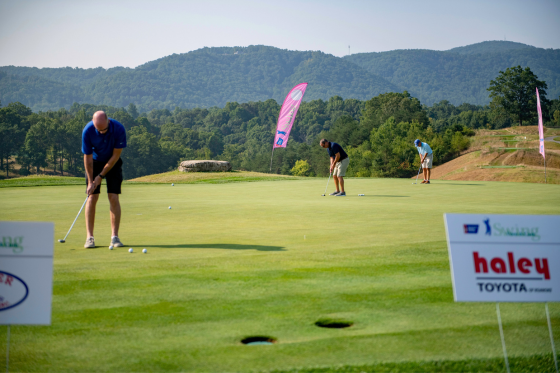
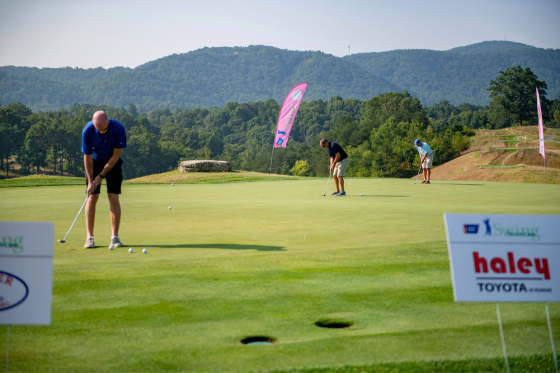
Three men practice their putts on the putting green, surrounded by sponsor signage at a golf fundraiser.

Golf tournaments offer nonprofits the chance to raise meaningful funds while raising awareness about their mission.

The Three Questions Every Golf Tournament Should Answer

Before you sell a single foursome, ask:

  1. Where are we including mission moments? Are there points before, during, and after the round where attendees genuinely encounter your mission, or does your cause only show up on the website?

  2. When are we making an invitation to give? Not a passive donation table. A real, human-centered invitation for people to become part of what you're building in a way that helps them to show their support, be recognized, and feel a true sense of belonging?

  3. Who are our key stakeholders, and are we deepening those relationships? Every tournament has people who are the real connective tissue: major donors, longtime sponsors, board champions. Is your event structured to honor those relationships, or are you too busy managing the scramble to find them in the crowd?

Mission Moments: Before, During & After

The SIRTA framework, drawn from neuroscientist Dr. Paul J. Zak's research and applied to fundraising events through our work, teaches us that people give most generously when they feel immersed in your story and the ask arrives at exactly the right moment. That means mission-building starts before anyone arrives on the first tee.

  • Before the round: A story at breakfast, a mission moment in the registration confirmation email, or a brief video at check-in begins the process of immersion that makes everything else more powerful.

  • During the round: A single signature hole where a volunteer shares a 60-second personal story with each foursome. Mission fact cards at tee boxes. Small design choices that compound across 18 holes and arrive at the clubhouse as a genuine emotional connection. How do you build your mission into the journey?

  • After the round where everything changes: When golfers gather for lunch or dinner, you have something rare: a relaxed, socially bonded group in peak relational openness. This is the moment your mission should step fully onto the stage, and where a well-designed paddle raise can transform a $50,000 golf day into a $150,000 mission experience.

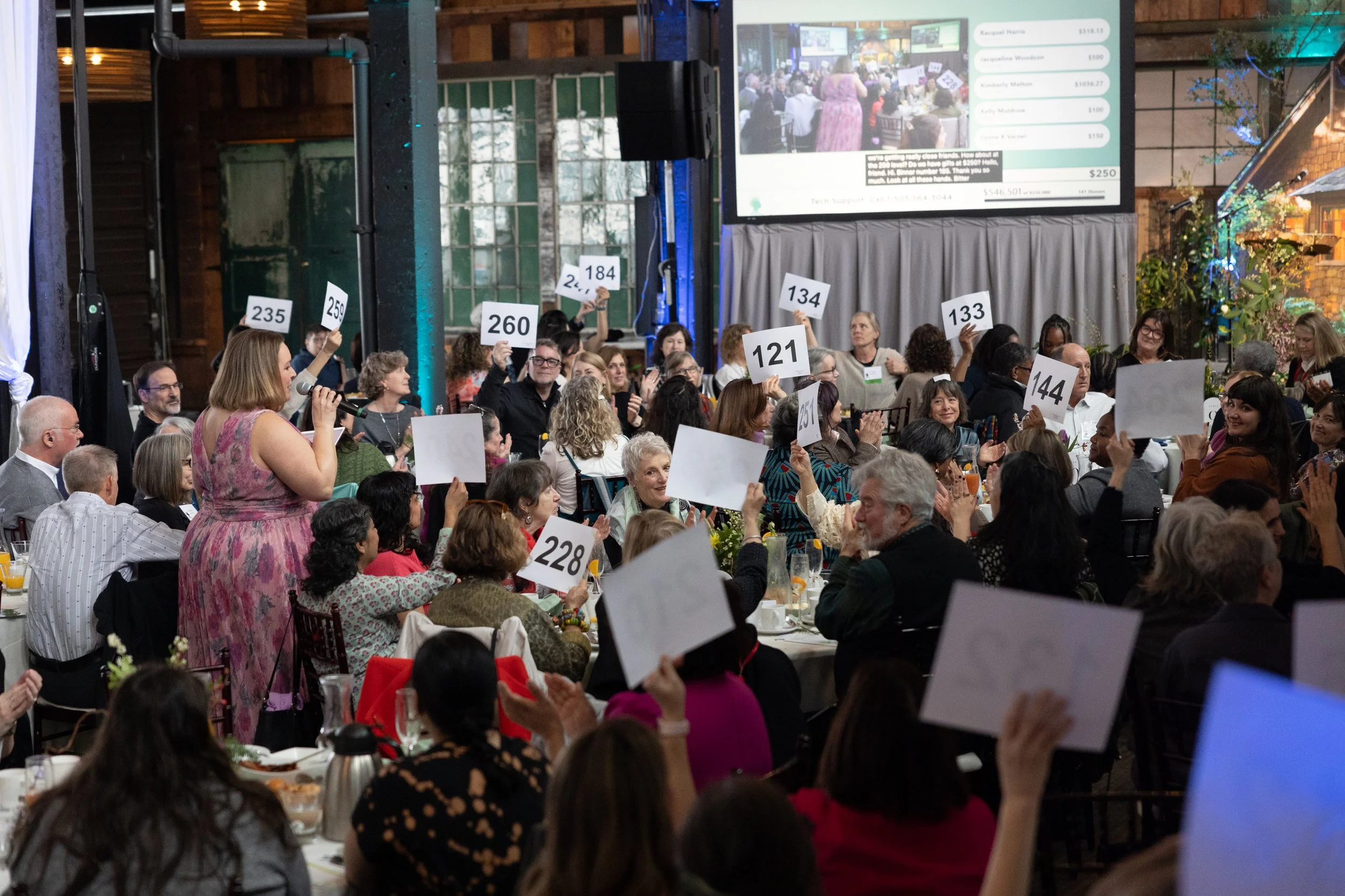
People seated at tables raise numbers as part of a fundraising event.

Take advantage of the relaxed, casual atmosphere following a golf event to further boost fundraising outcomes.

Sit People Down. Tell the Story. Make the Ask.

You cannot raise the most money while people are standing up and half-distracted. The post-round meal is not just an award ceremony; it's your single greatest fundraising opportunity of the day.

A strong post-round fundraising program includes:

  • A mission-first welcome. Put your organization on stage to welcome guests and speak to the mission

  • An impact story. First-person, specific, human, told by someone close to the impact

  • A clear ask. An invitation to belong, with specific dollar amounts tied to real impact

  • An authentic close. Connecting each gift back to the mission, not just expressing gratitude for attendance

Twenty-five minutes, designed well, can raise more than the rest of the day combined. But it requires intentional structure, a skilled facilitator, and a story that has been crafted, not improvised.


Annual Event Audit

Want to go deeper on special appeal strategy? Swaim Strategies’ Annual Event Audit evaluates exactly this moment and helps you build a program that converts goodwill into real revenue.


Protect Your Team’s Time for What Actually Works

Games and gimmicks are fun, easy to sell, and create surface-level energy. But when not done well, they can be labor-intensive, and every hour your team spends running a closest-to-the-keg contest is an hour not spent with the donors who will sustain your mission for years.

The highest ROI use of your team’s attention, every time, is relationship. The board member who sits with a major sponsor during cocktail hour. The executive director who walks the course and introduces herself to every foursome. The development director who has three conversations she came specifically to have.

Those moments don't happen by accident. They happen because you protected time for them.

When auditing your tournament, look at every item on your schedule and ask: Does this bring us closer to the people who matter most, or does it fill the day with noise? Fun is important. A few moments of chance and joy are valuable. But sometimes less is more. Focus your energy first on the relationships, then sprinkle in the little joy bombs along the course.

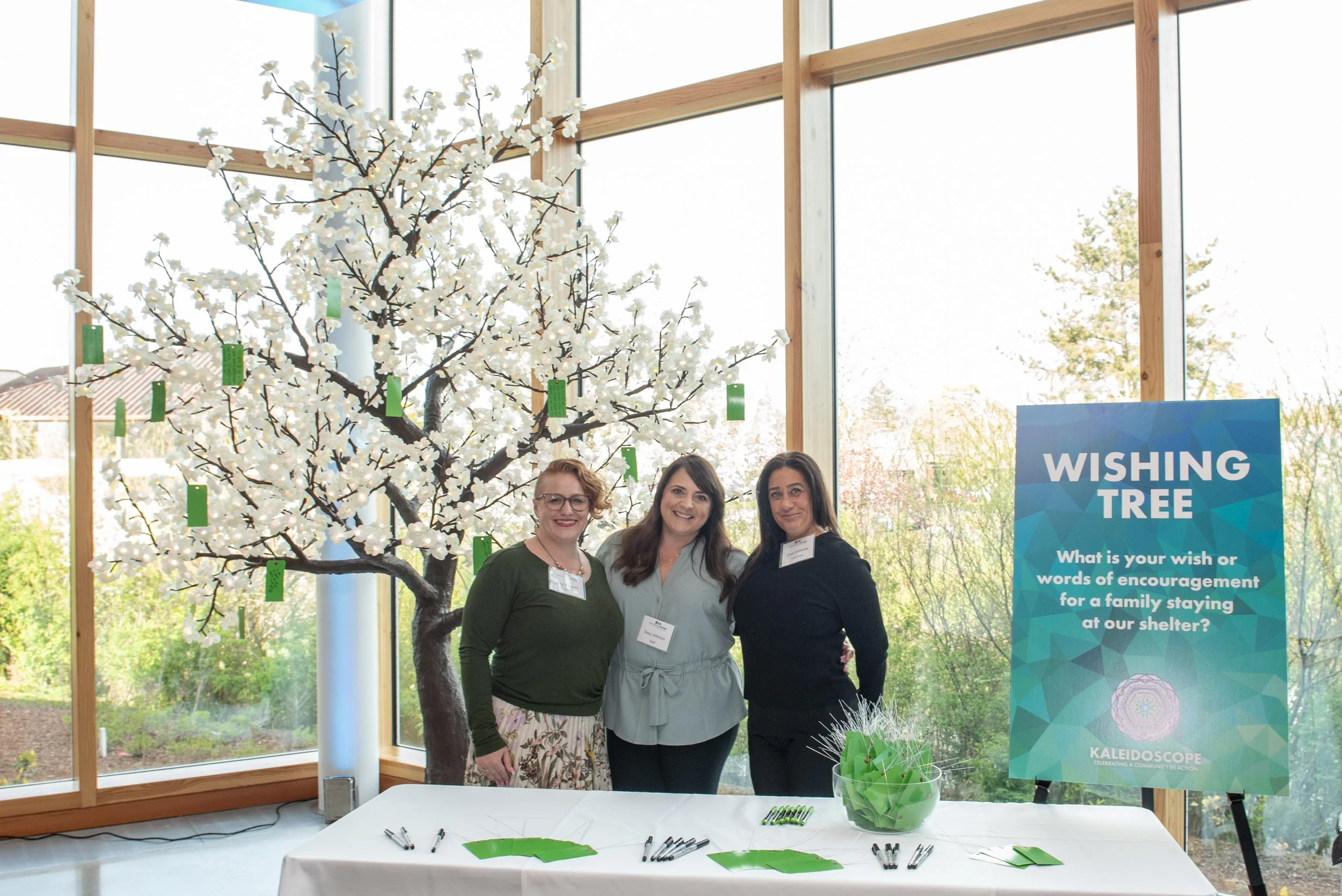
Three women pose behind a table at a fundraising event, inviting people to write words of encouragement.Three women pose behind a table at a fundraising event, inviting people to write words of encouragement.

Look for ways to bring people closer to your mission and build relationships throughout your fundraising event.


Your Golf Tournament SIRTA Audit Checklist

Use this checklist to evaluate your tournament through the SIRTA framework and find your greatest opportunities for growth.

🟢 S — STAGING

Have you set the conditions for connection before the first swing?

  • Registration confirmation email includes a mission story or impact statement
  • Welcome signage and arrival experience speak to mission, not just logistics
  • Pre-round gathering includes a brief mission moment in a story, video, or speaker
  • Volunteers and committee members welcome people and host them

🔵 I — IMMERSION

Are attendees being drawn into your story throughout the day?

  • At least one hole features a personal mission story shared by a volunteer or beneficiary
  • Tee box cards or hole signage include mission facts or impact data
  • The post-round program is designed as a fundraising experience, not just a celebration
  • Connection is intentional with key stakeholders positioned for relationship and mission exposure

🟡 R — RELEVANCE

Are you connecting your mission to what this audience cares about?

  • Your mission story features someone your audience can personally connect with
  • Your ask is framed around the impact a gift makes, not your organization's needs
  • You know why your key sponsors are here and have tailored their experience accordingly
  • Your post-round speaker reflects the lived experience of your mission community

🟠 T — TARGETING

Are you reaching the right people with the right message at the right moment?

  • You have identified your top three to five stakeholders in advance and have a relationship plan for each
  • Board members have been briefed and assigned specific relationship responsibilities for the day
  • Giving levels in the special appeal are calibrated to the capacity of the people in the room
  • You have a follow-up plan for new relationships within 48 hours of the event

🔴 A — ACTION

Are you making a clear, confident, human-centered invitation to give?

  • Your tournament includes a dedicated, seated fundraising moment, not just a donation table
  • A story is told by a person with a direct connection to your mission
  • Giving levels are specific and impact-driven
  • Both digital and paddle/card giving options are available so no one is excluded
  • Every donor receives a personal thank you within 24–48 hours connecting their gift to impact
  • Next year's tournament is mentioned to sponsors before they leave

About Swaim Strategies

Swaim Strategies is a fundraising event consultancy dedicated to elevating nonprofit impact through events, strategy, and storytelling. Start a conversation with their team.

More Resources from Swaim Strategies

🎙️ The Fundraising Elevator Podcast

📋 Annual Event Audit

📖 Planning a Successful Major Donor Event Book

🆘 Gala 911: On-Demand Event Consulting

🎟️ The Elevate Conference