
Fundraising Event Trends: Why People-Centered Events Win
Golf is a Relationship Sport—The 2026 Data Says Fundraising Is, Too
by Samantha Swaim, Founder and Fundraising Event Consultant at Swaim Strategies
Four hours on a course does something a ballroom rarely can. It strips away the formality. It puts four people in a cart, side by side, with time to talk. That is why the charity golf tournament remains one of the most resilient fundraising events in the nonprofit toolkit.
But the ground under every fundraising event is shifting. The 2026 numbers give us a clearer picture. Fewer people are giving, the people who stay are giving more, and the events that win are built around human connection rather than headcount.
If you produce golf tournaments, this is good news. Here are six fundraising event trends that shaped 2026, what the research says, and how to put them to work on your course.
Trend 1: Fewer Donors, Deeper Relationships
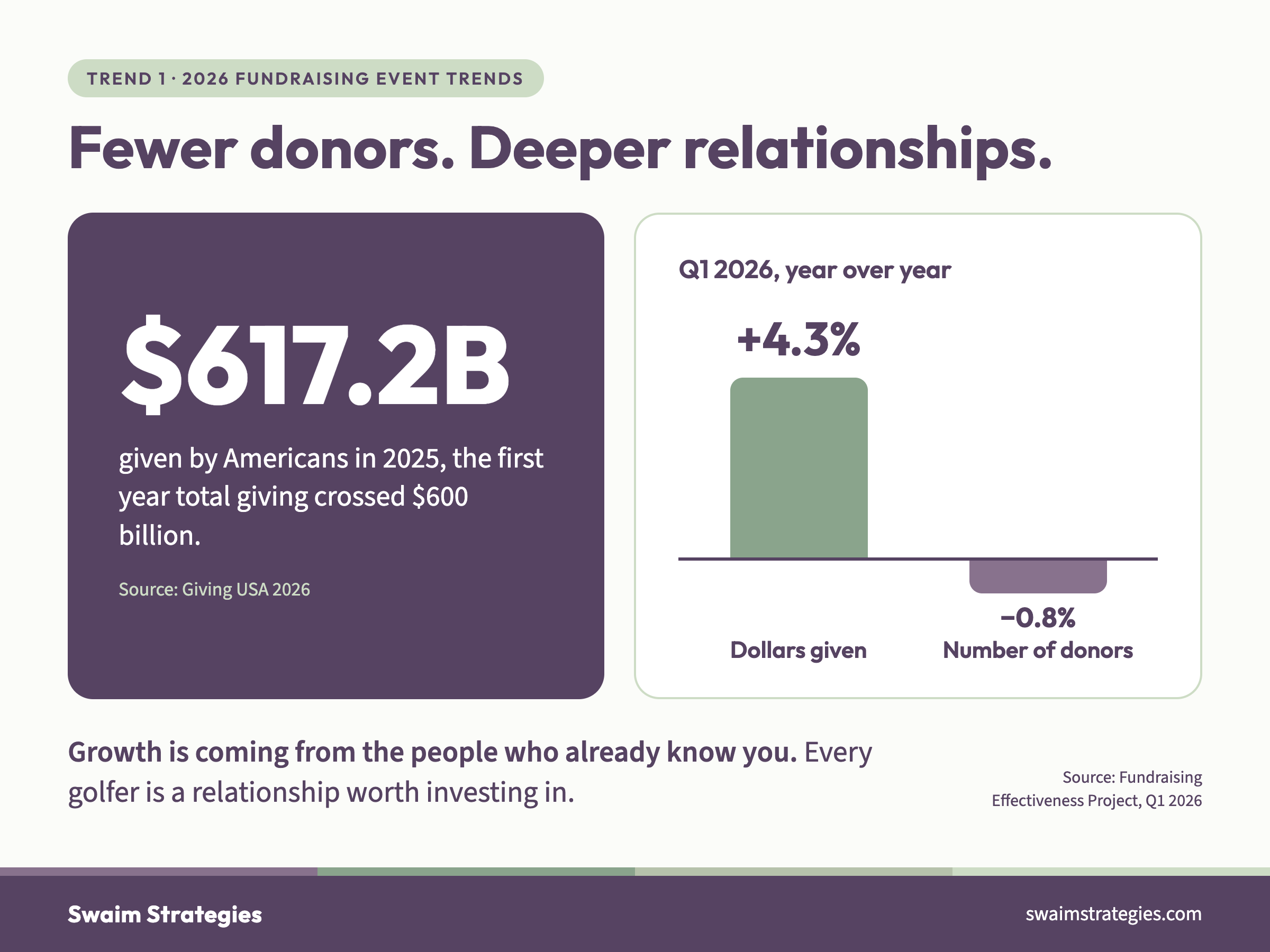
Americans gave a record $617.2 billion in 2025, the first time total giving crossed $600 billion, according to Giving USA 2026. Yet the same report shows fewer Americans are participating.
The quarterly data confirms it. The Fundraising Effectiveness Project found that in the first quarter of 2026, dollars rose 4.3% while the number of donors fell 0.8%. Growth is coming from existing and returning supporters, not from new ones.
Meanwhile, the Center for Effective Philanthropy reports that 69% of nonprofits lost funding from at least one source in 2025. Many are turning to individual donors to close the gap.
What this means for your tournament: Every golfer is now a relationship worth investing in. The question is no longer, "How do we fill foursomes?" It is, "Who should be on this course, and what should they feel when they leave?"
Trend 2: Smaller, Curated Fields Can Outperform Full Ones
Bigger is not automatically better. In a recent Swaim Strategies case study, a museum gala turned 75 guests into $400,000. The strategy started with a donor prospect map, not a venue. Every seat was a deliberate decision, and every guest had a named relationship holder and a defined outcome for the night.
The same logic applies on the course. A curated field lets you:
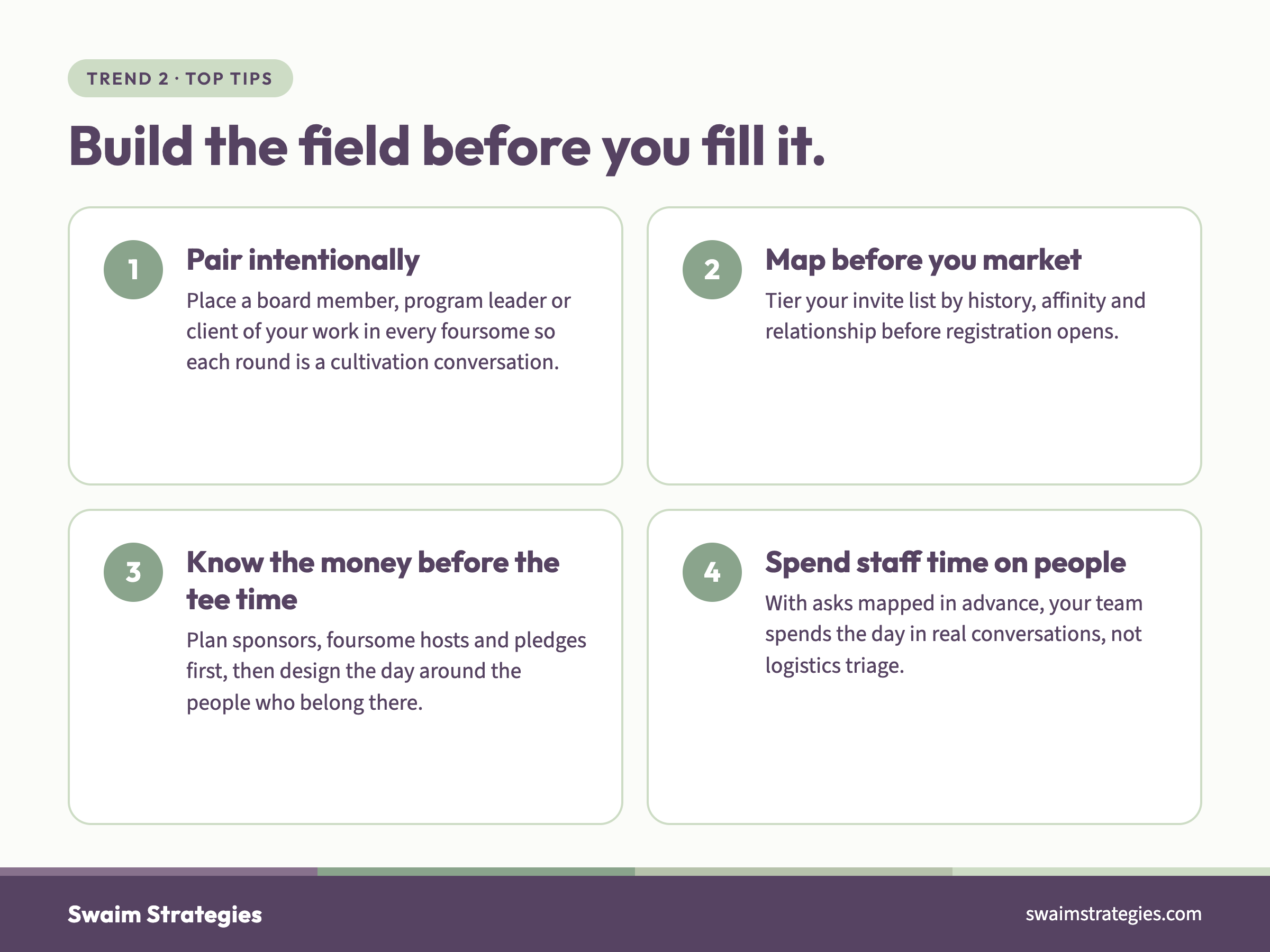
Pair intentionally. Place a board member, a program leader, or a client of your work in each foursome so every round is also a cultivation conversation.
Map before you market. Tier your invite list by history, affinity, and relationship before you open registration.
Know the money before the tee time. Plan sponsorships, foursome hosts, and pledges first, then design the day around the people who belong there.
Spend staff time on people, not logistics. When asks are mapped in advance, your team spends the day in high-value conversations instead of triage.
A smaller field also costs less to produce. That matters when every dollar raised needs to reach the mission. If you are unsure where to start, a strategic plan for your fundraising event builds the revenue architecture before you book a single cart.
Trend 3: Belonging & Mission Bring People Back
People don’t come back just for the scramble format. They come back because they felt part of something.
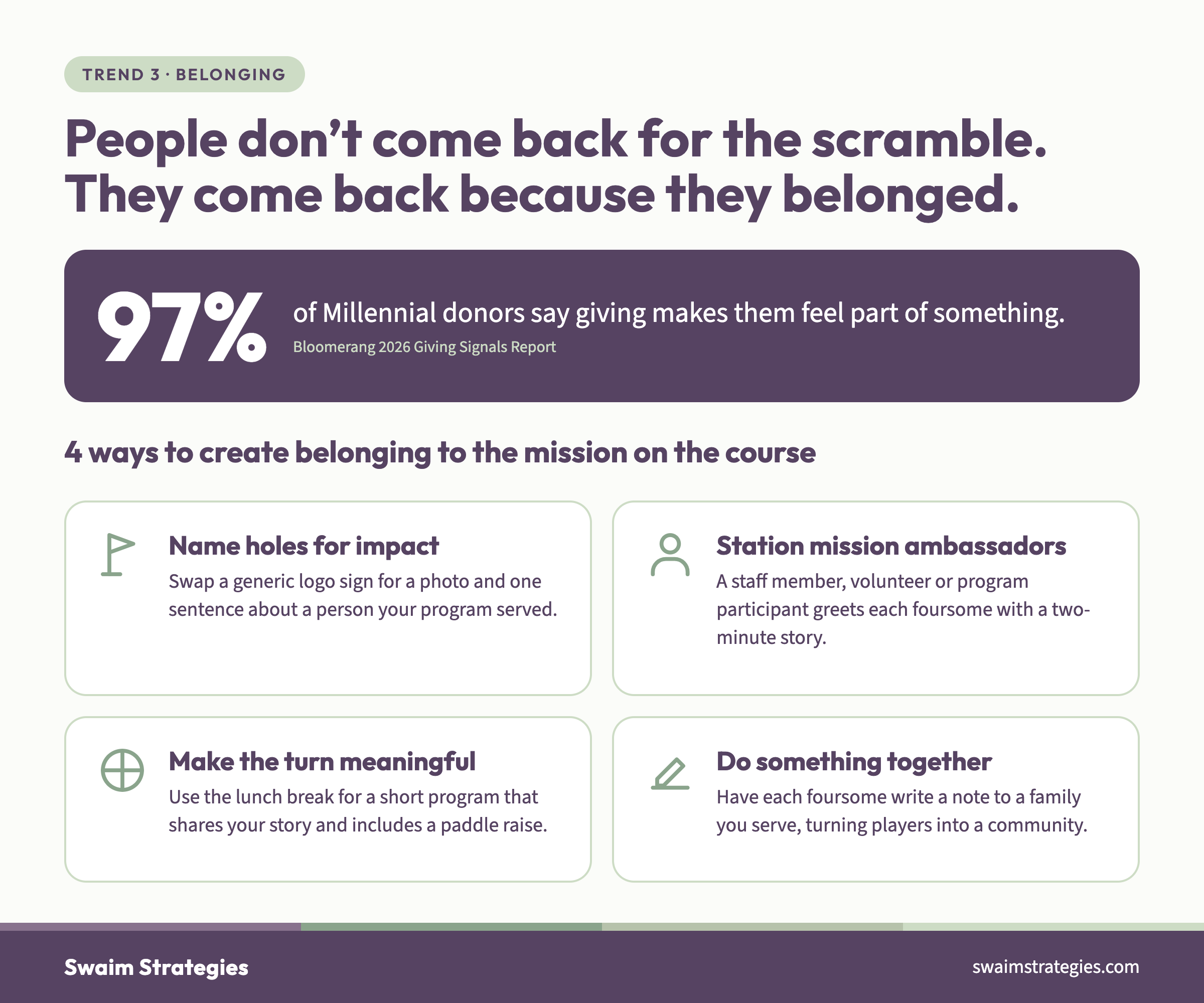
The Bloomerang 2026 Giving Signals Report found that 97% of Millennial donors say giving makes them feel part of something. Belonging is now a reason people give the first time, not just a reason they stay. And 80% of Millennials plan to support at least one new nonprofit this year. Many of them are the young professionals now joining the game in record numbers, as GolfStatus notes in its guest post on golf fundraising trends.
Giving circles show the same pull. According to the Johnson Center for Philanthropy, 4,000 giving circles mobilized 370,000 people to give $3.1 billion between 2017 and 2023, and the movement is on track to double. People want to give together.
A mission-centered golf tournament gives them that. Some ways to bring the mission onto the course:
Name holes for impact. Replace a generic logo sign with a photo and one sentence about a person your program served.
Station mission ambassadors. Put a staff member, volunteer, or program participant on a hole to greet each foursome and share a two-minute story.
Make the turn meaningful. Use the lunch break for a short program that shares your story and includes a paddle raise.
Let golfers do something together. A team challenge tied to your mission, like each foursome writing a note to a family you serve, turns individual players into a community.
Trend 4: Story-based Programs Turn Golfers Into Donors
Many golf tournaments raise money from registrations and sponsors, then treat the awards dinner as a wrap-up. In 2026, the dinner was where the real fundraising happened, if the program was designed for it.
Event professionals are naming the shift directly. A 2026 gala trends session from Auctria points to a return to human-centered fundraising, with storytelling as the backbone that still raises the most money. The Swaim Strategies case study puts it simply: mission immersion beats mission messaging. Guests who touch the work do not need to be convinced of its value.
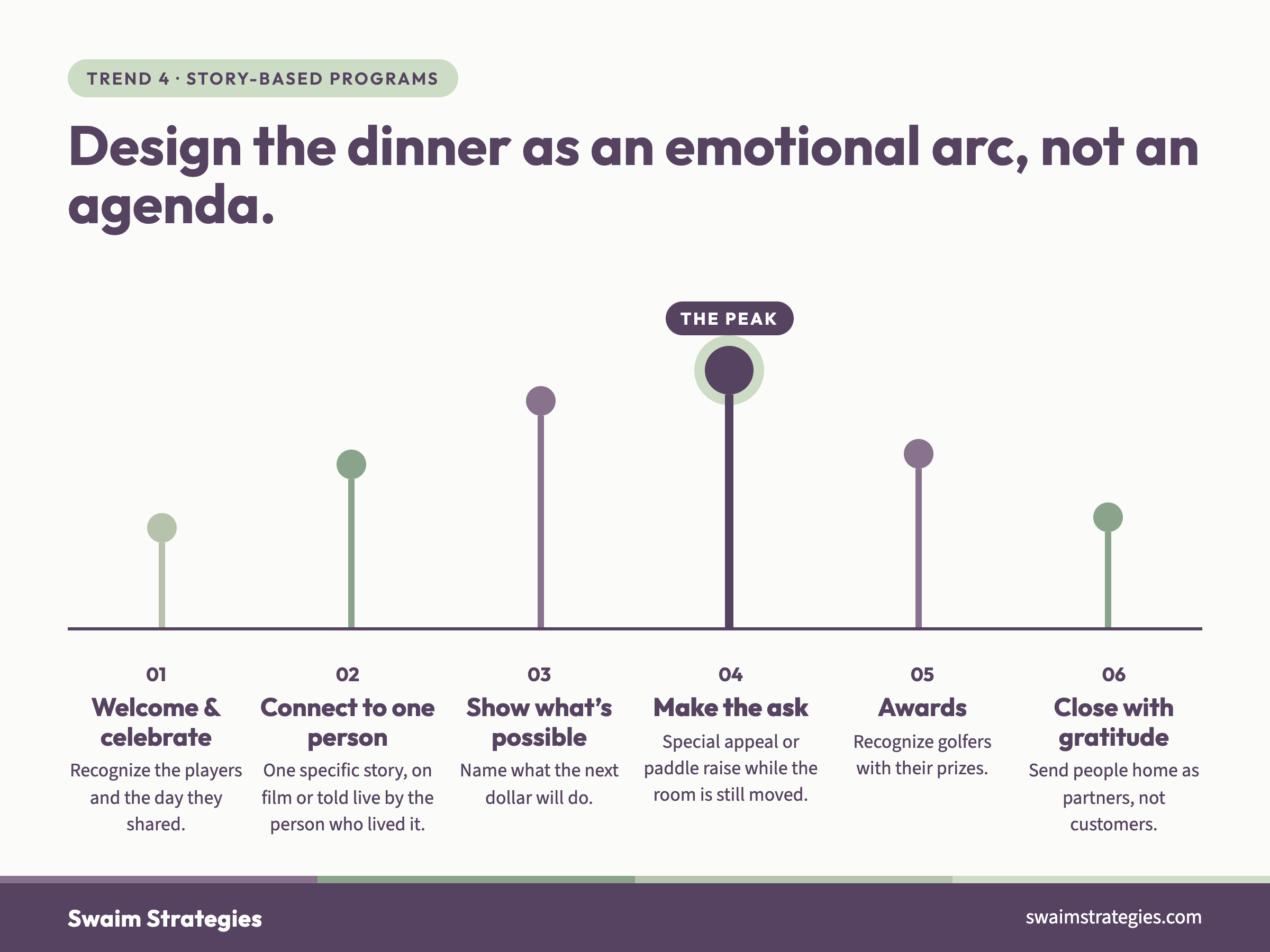
Design your post-round program as an emotional arc, not an agenda:
Welcome and celebrate. Recognize the players and the day they shared.
Connect to one person. Share a single, specific story, in a short film or told live by the person who lived it.
Show what is possible. Name what the next dollar will do.
Make the ask at the peak. Invite a special appeal or paddle raise while the room is still moved.
Close with gratitude. Send people home feeling like partners, not customers.
New tax rules give you a natural ask level, too. Starting in 2026, people who do not itemize can deduct up to $1,000, or $2,000 for joint filers, according to Husch Blackwell. Some fundraisers are framing a $1,000 gift as a new tax-smart giving level.
If writing the program feels daunting, complete event scripting and mission-driven video production can help you build the arc from welcome to final thank-you.
Trend 5: Sponsors Want Partnership, Not Just a Tee Sign
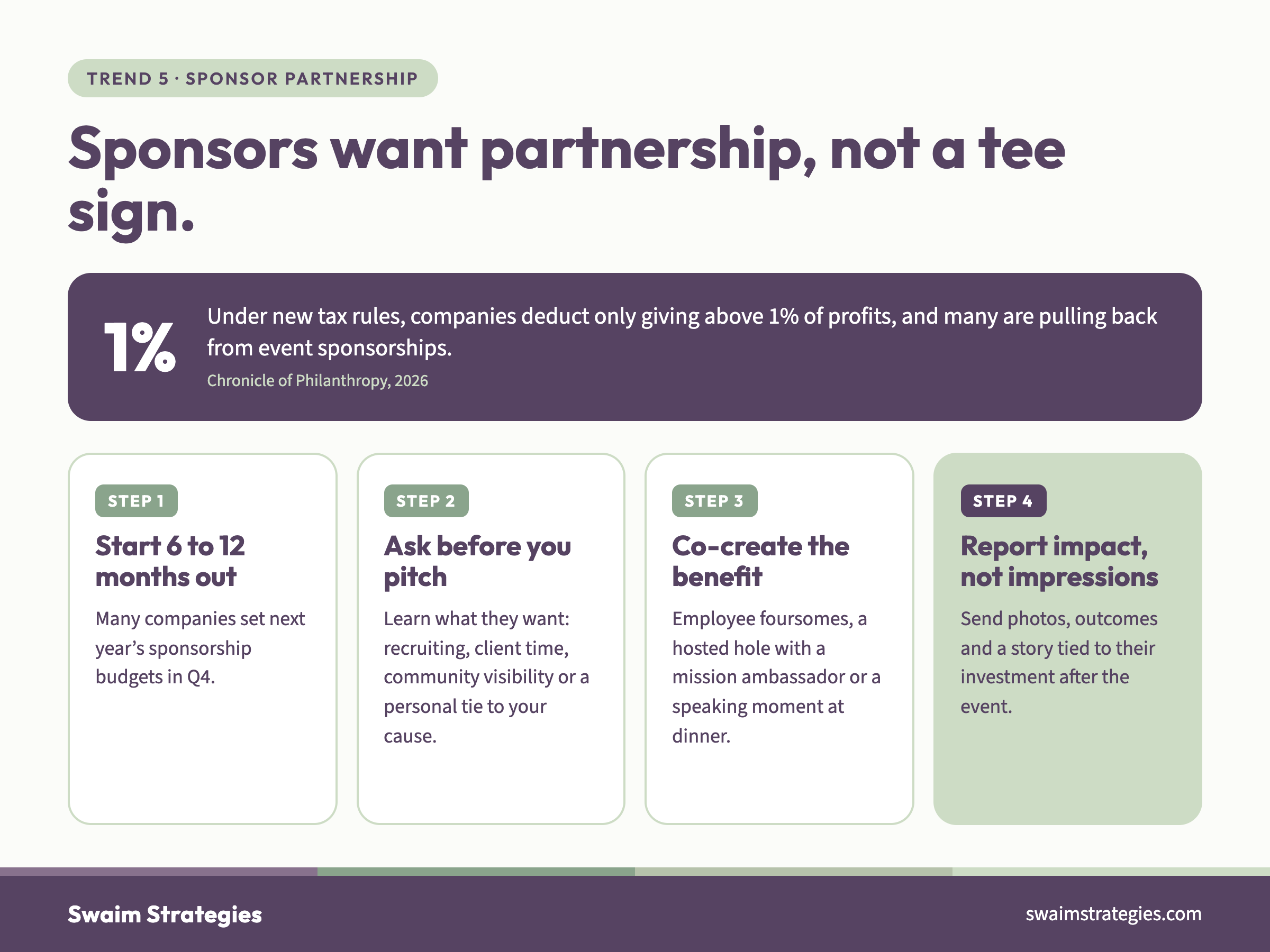
Corporate support is under pressure. The Chronicle of Philanthropy reports that businesses are pulling back from event sponsorships and table purchases. A new tax rule now gives companies a deduction only on giving above 1% of profits.
For golf tournaments, where sponsors are often the financial backbone, this is a wake-up call. The tournaments that keep sponsors are the ones that treat them as partners. As I wrote in Smarter Sponsorship Strategies for Your Charity Golf Tournament, your sponsorship menu is a conversation starter, not the final word.
What partnership looks like in practice:
Start six to 12 months out. Many companies set sponsorship budgets in Q4 for the following year.
Ask before you pitch. Learn what a business is trying to accomplish: recruiting, client time, community visibility, or a personal connection to your cause.
Co-create the benefit. Offer employee foursomes, a hosted hole with a mission ambassador, or a speaking moment at dinner.
Report impact, not impressions. Send photos, outcomes, and a story connected to their investment after the event.
For more ideas, see the 9 proven sponsorship strategies for charity golf tournaments.
Trend 6: The Relationship Starts After the Final Putt
The tournament is not the finish line. It is the first tee of a longer relationship.
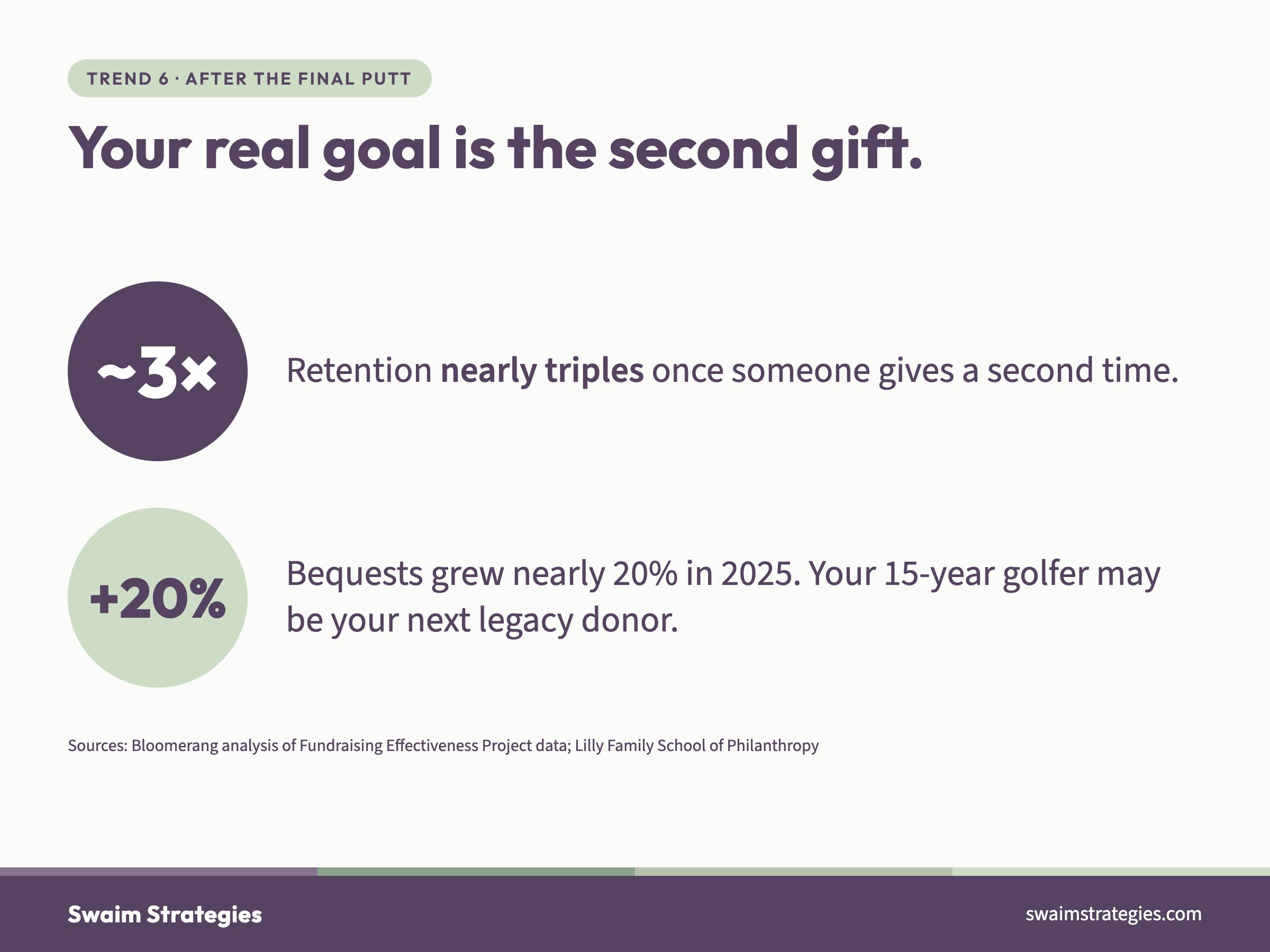
Retention is where the opportunity hides. Donor retention sat at just 18% in early 2026, per the Fundraising Effectiveness Project. Yet Bloomerang's analysis of FEP data shows retention nearly triples once someone gives a second time. Your job after the tournament is to earn that second gift.
Legacy giving rewards the long view as well. Bequests rose nearly 20% in 2025, the fastest growth of any source, according to the Lilly Family School of Philanthropy. The golfer who has played your tournament for 15 years may be your next legacy donor.
Build a follow-up rhythm:
Within 48 hours: Make personal thank-you calls to sponsors, foursome hosts, and first-time players.
Within 2 weeks: Send an impact note with photos and the story of what their day made possible.
Within 90 days: Invite donors to see the mission up close, such as a site visit or volunteer shift.
Before next year's invite: Have a personal conversation with your top supporters about their goals and how they want to be involved.
An annual event audit is a smart way to see where your tournament is building relationships, and where it is leaving them on the course.
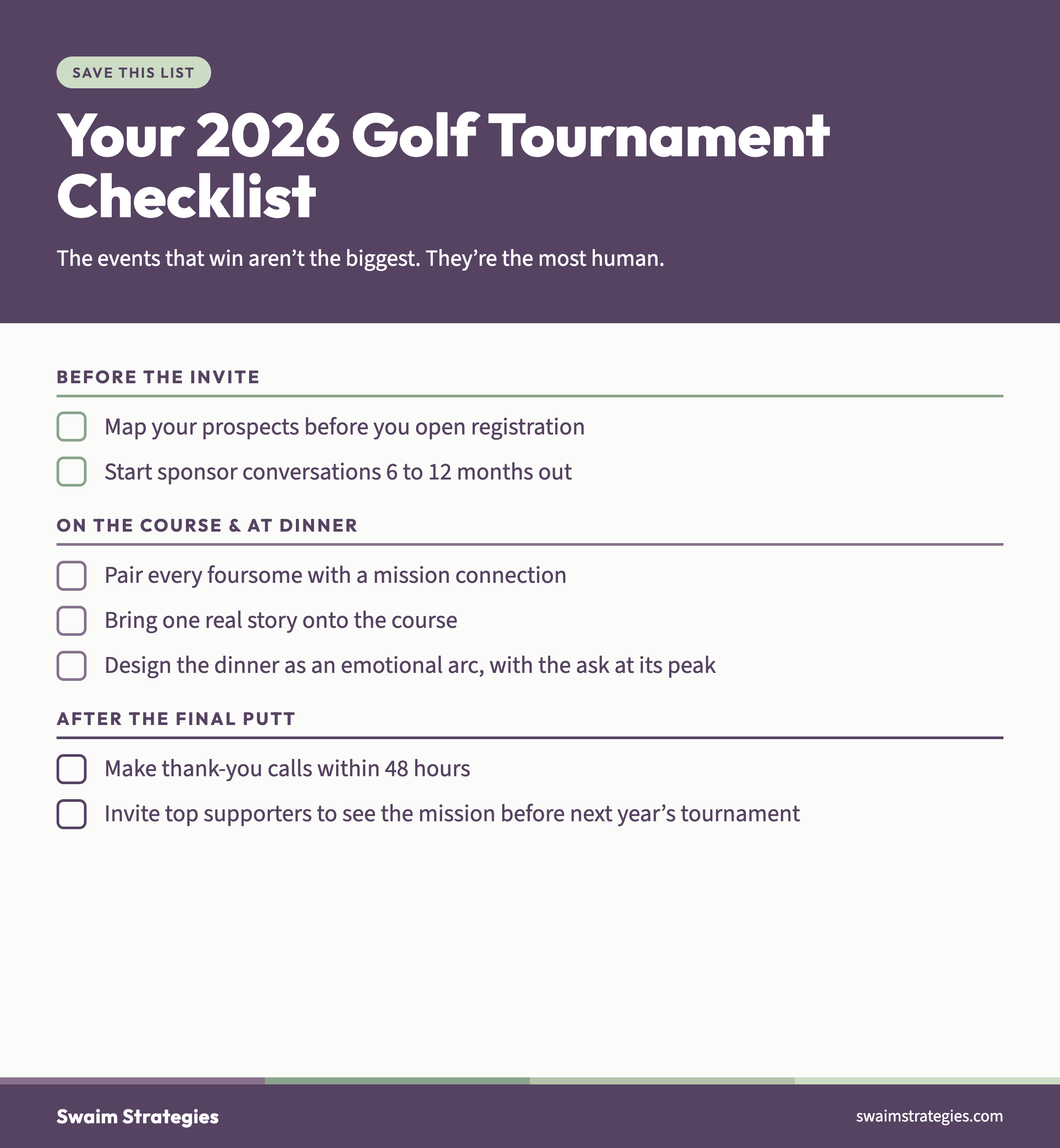
Your Next Golf Tournament Checklist
Ready to Make Your Next Tournament About People?
The 2026 data is clear. The events that win are not the biggest. They are the most human. They bring the right people together, connect them to the mission through story, and keep the relationship going long after the last putt drops.
At Swaim Strategies, we believe in the power of bringing people together to create movements and raise support for your mission. Book an on-demand strategy session or request a proposal to design a golf tournament your players will never forget.
Keep learning with Swaim Strategies
The Fundraising Elevator Podcast, with Sam Swaim and Kristin Steele on the latest fundraising event trends
Planning a Successful Major Donor Event, the book by Samantha Swaim and Kristin Steele
The Elevate Conference, the annual gathering for fundraising event professionals
The Swaim Strategies Substack for strategic ideas in your inbox