
How to Price, Package & Sell Mulligans for Your Golf Event
by Jen Wemhoff, Communications Manager at GolfStatus
Mulligans are a low-lift option to add real revenue to your charity golf tournament. They cost you nothing to offer, golfers of all skill levels love them, and they’re one of the easiest add-ons to any golf tournament.
Many golf tournament organizers leave money on the table by either not offering mulligans at all or not pricing, packaging, and selling them effectively. Learn how to leverage mulligans for your next tournament.
What is a Mulligan?
A mulligan is simply a “do-over” or a chance for a golfer to retake a shot without it counting against their score.
Mulligans aren’t allowed in professional or official competitions, but are a staple of charity tournaments. They’re less about strict rules and more about fun and raising money for your cause. Golfers who shank a tee or approach shot are usually more than happy to pay a few dollars to erase it and keep the round moving.

Golfers who hit a poor tee shot are happy for the chance for a “do-over” by using a mulligan.
How to Price Mulligans
There’s no single “right” price—it depends on your tournament, format, competitiveness, and what golfers are used to paying. Here are a few general suggestions:
Casual charity tournaments: $5-$10 per mulligan. A reasonable price point keeps sales volume high.
Competitive or higher-end tournaments: $15-$25 per mulligan. Golfers at higher-end events tend to have more discretionary income to spend and can justify the higher cost.
Bundles: Selling mulligans as a set—for example, three mulligans for $20 instead of $10 each—encourages golfers to buy more than they might as a single.
Whatever price point you decide, think about it the way you think about sponsorship and registration packages. Even though most golfers at a charity event already know they’re there to support a cause, you still want to offer value, and they’re generally willing to spend accordingly.
Pro Tip: Ask for feedback on mulligan pricing in your post-tournament communications with golfers to help you lock in options for next year.
Building Mulligan Packages That Sell
Pricing is only half the equation. How you package mulligans can have a big impact on whether or not golfers decide to buy them. Consider these mulligan package options:
Bundle them into team registration. Consider an upgraded registration tier that includes a set number of mulligans per golfer or team, so those who want the cushion of a mulligan don’t have to make a separate purchase decision later.
Sell them as a standalone add-on. Not everyone wants mulligans bundled in—and some golfers may want additional mulligans than what’s included with a package. Give them the option to add mulligans à la carte during registration and at check-in.
Fold them into VIP or premium packages. Another option is to pair mulligans with other perks, like premium parking, extra raffle tickets, or contest entries, to make an upgrade package feel like a deal rather than an upsell.
Offer tiered mulligan bundles. Offer a “basic” bundle of two or three mulligans at a lower price, and an “upgraded” bundle of four or five at a better price per mulligan to give golfers options without overcomplicating the package.
Pair mulligans with raffle tickets. Golfers who buy one of these are often receptive to the other, so consider offering a combo package that includes both mulligans and raffle tickets.
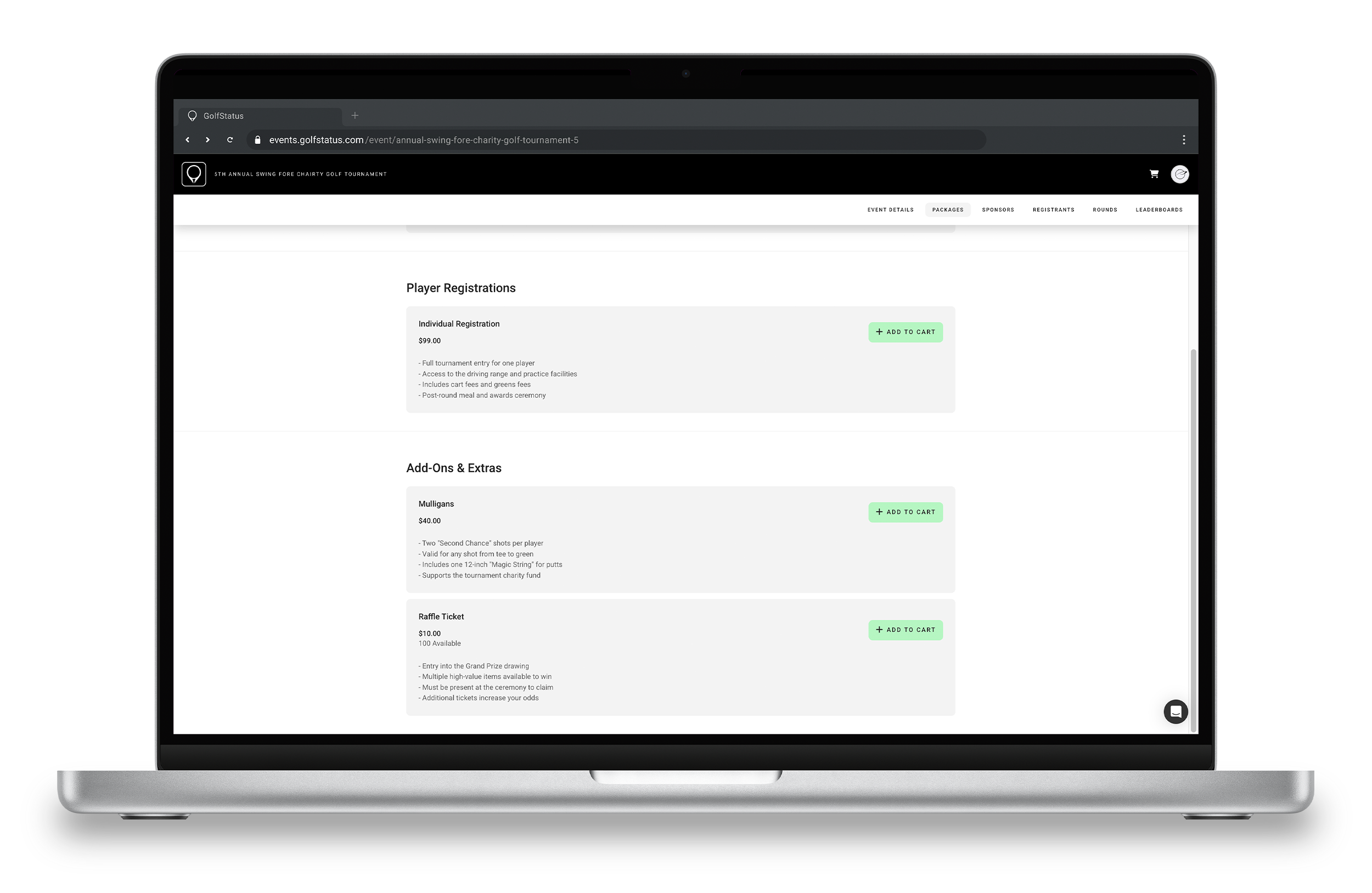
List a mulligan package on your event website to make it as easy as possible for golfers to buy them.
The goal with any package for mulligans is to make the decision easy. Keep your menu of options simple and clearly priced on your event website so golfers can make their selection without having to think through a ton of choices.
Where & How to Sell Mulligans
Mulligans sell best when they’re easy to buy in the moment someone’s already thinking about them, so it’s a best practice to offer them before the tournament and at the course.
At registration. Include mulligan options in the online registration flow so golfers can add and pay for them without a separate transaction. This is the prime converting moment, since golfers already have their credit card out and are ready to buy.
At check-in. Some golfers wait until tournament day to decide, and others may want to add additional do-overs, so make sure mulligans are just as easy to purchase when they arrive at the golf facility.
On the course. Consider setting up a mulligan station or two near the tee box of notoriously tough holes. A well-timed mulligan offer right before a challenging hole can be one of your highest-converting moments of the day.
Across all three touchpoints, the common thread is removing as much friction as possible. If buying a mulligan means finding cash, hunting down a volunteer, or filling out a form, you’ll lose sales. A mobile-friendly event website lets golfers buy mulligans (or anything else) right from their phones, wherever they are in the course, keeping the process quick and easy and eliminating the headache of tracking and reconciling cash payments.
Pro Tip: Post QR codes that link directly to the mulligans package on your event website at the check-in table and any mulligan stations for easy access.

Direct golfers to your mobile-friendly event website to purchase mulligans at the event, eliminating the need to hassle with and reconcile cash payments.
Communicate Rules to Keep It Fun & Fair
Mulligans work so well because they’re lighthearted, not because they let anyone buy their way to winning a tournament. It’s crucial to set clear limits and expectations up front. A common approach is limiting mulligan purchases to two to four per golfer and specifying where they can be used, such as for tee shots only. Communicate the rules on your event website and again at check-in so there’s no confusion, frustration, or push-back mid-tournament. You might even post signage that explains mulligan usage.
Physical mulligan cards, tickets, or wristbands can help volunteers and other golfers see at a glance who has purchased them and how many they have left, which cuts down on disputes and keeps the pace of play moving.
Mulligan FAQs
Why should we offer mulligans at our tournament?
For nonprofits, golfers’ willingness to pay is a golden opportunity. Mulligans require no inventory, vendors, or setup, beyond deciding your pricing and how you’ll sell them, which means every dollar collected goes straight toward your mission.
Are mulligans allowed at all golf tournaments?
Mulligans aren’t utilized in official or professional competitive tournaments, but they’re standard practice at charity events and other casual formats where the focus is fun and fundraising. As the organizer, you get to set the rules for your own event.
How many mulligans should we let golfers buy?
Most tournaments cap purchases somewhere between two and five per player. Capping the number keeps the format fair and prevents mulligans from feeling like a way to buy a win rather than the fun add-on they’re intended to be.
Where on the course can golfers use mulligans?
Many tournaments limit mulligans to tee shots only to keep play moving and avoid disputes over lies in the fairway or on the green. That being said, you can allow them for any shot—the key is to communicate the expectations clearly before the round starts so there’s no confusion. Mulligans can’t typically be used on hole-in-one contest holes and in putting contests.
Do we need physical mulligan cards?
Physical cards or wristbands give volunteers an easy way to verify purchases and their use on the course. Selling them through your event website ahead of time (or from a phone on tournament day) cuts down on the need to handle cash and makes reporting easier post-tournament. If golfers buy them ahead of time, have them ready for pick-up at check-in.
Should mulligans be included in registration or sold separately?
Both approaches work, and offering them both ways helps you capture the most revenue possible. Bundle a set number into an upgraded registration or VIP package for golfers who want the cushion built in, and offer them as a standalone add-on for everyone else.
What’s a reasonable price to charge for mulligans?
It depends on your event, goals, and field, but $5-$10 per mulligan is typical for charity golf tournaments. Higher-end events may be able to charge $15-$25 per mulligan. Bundling mulligans together at a slight discount usually outperforms selling them individually.
Turn a Small Add-On Into Real Revenue With Mulligans
Mulligans won’t replace sponsorships or registrations in terms of revenue, but they’re an easy win to fold into your tournament. With thoughtful pricing, a simple package structure, and a frictionless way to buy, mulligans can add meaningful dollars to your tournament’s fundraising outcomes, all from something golfers already want.
Mulligans are a great way to build in easy, low-cost revenue drivers to charity golf tournaments. Make it easy to package, list, and sell with a free event website from GolfStatus. Websites are powered by GolfStatus’ golf event management platform, which streamlines and simplifies tournaments to save organizers time and help raise more money for your cause, and backed by a team of golf fundraising pros. Book a meeting to find out more and get started at no upfront cost!
About the Author
Jen Wemhoff - Communications Manager at GolfStatus
Jen Wemhoff accidentally discovered her passion for nonprofits in college. An internship while earning a degree in Communications from Doane University led to a 20 year career in the nonprofit sector, where she found a strong desire to be part of something bigger than herself. Her vast nonprofit experience includes roles in marketing, fundraising, and direct programming. When Jen came to GolfStatus as Communications Manager in 2020, she was struck by the power of the sport to raise money to power nonprofit missions. She tells GolfStatus’s story across platforms and channels and develops educational tools and resources to help nonprofits tap into golf’s giving power. Jen, her husband, and two daughters call Lincoln, Nebraska home.